Traditional interviews often tell you who is best at interviewing. They do not always tell you who will perform, adapt, solve problems, or help your company grow.
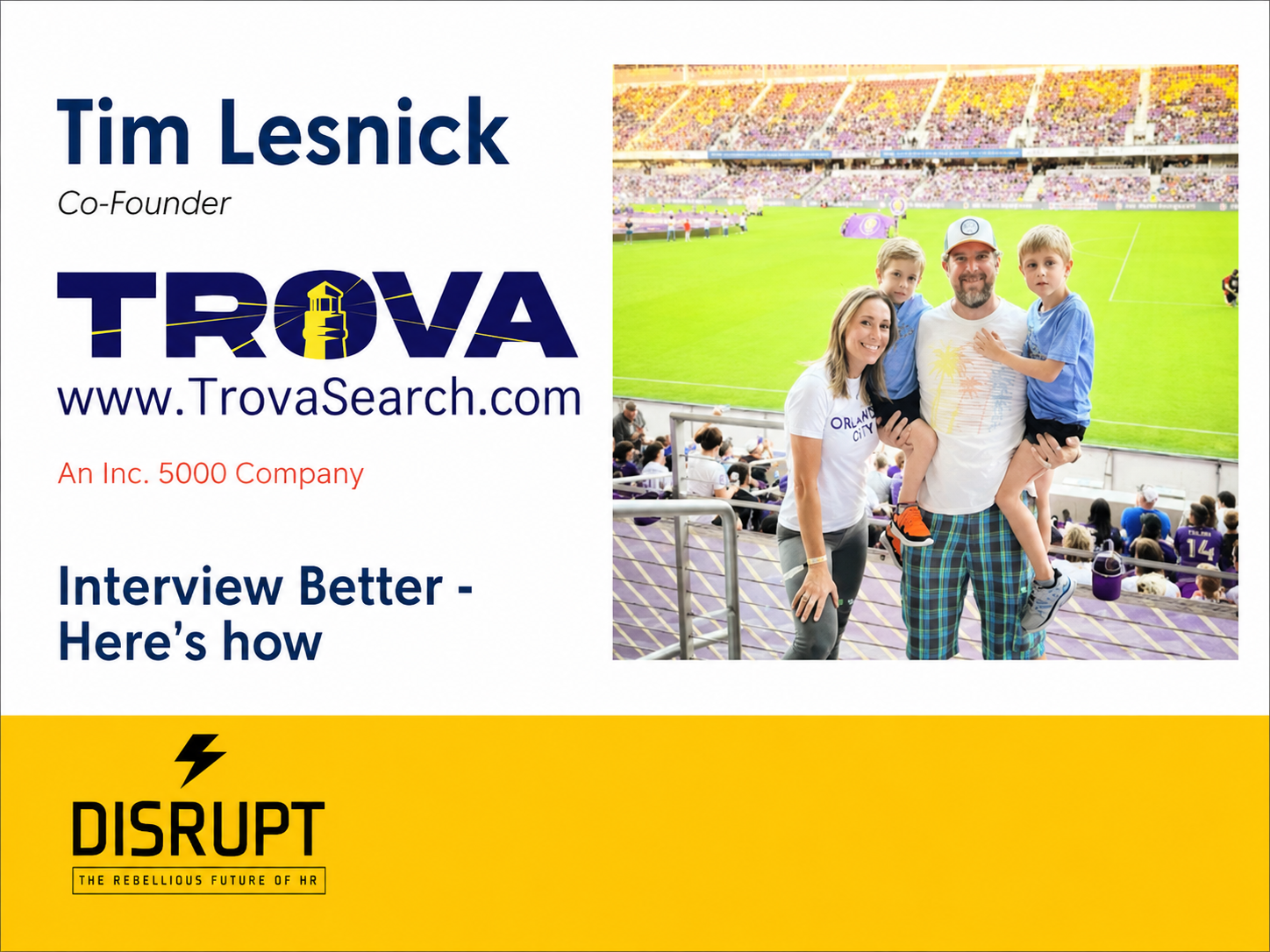
In his DisruptHR talk, “Interview Better—Here’s How,” on May 29, 2025 at DisuprtHR Orlando 20.0, Trova co-founder Tim Lesnick challenges employers to rethink the polished, predictable interview process that has shaped hiring for decades.
His message is direct: stop treating interviews like scripted tests. Start having conversations that reveal the person behind the resume.
Watch Tim’s DisruptHR talk below, then explore how your company can build a more useful and revealing interview process.
Traditional Interviews Are Like Bad First Dates
A conventional interview can feel like a bad first date.
Everyone arrives on their best behavior. The interviewer asks familiar questions. The candidate gives polished answers. Both sides try to make a strong impression.
Unfortunately, the person you meet during that carefully managed conversation may not be the same person who shows up after 90 days on the job.
Most candidates have heard questions such as:
- Tell me about yourself.
- What is your greatest weakness?
- Where do you see yourself in five years?
- Why should we hire you?
- Do you work well under pressure?
They know the questions are coming. They can search for recommended answers, rehearse their responses, and study the language in your job description.
As Tim explains in the talk, employers may unintentionally give candidates the answers to an open-book test. The interview then measures how well someone prepared for the interview—not necessarily how well that person will perform the job.
That is why the smoothest speaker in the room is not always the strongest hire.
Stop Interviewing From the Job Description
A job description can help define a position, but it should not control the entire interview.
Many job descriptions are outdated, overly broad, or copied from a previous version of the role. They may list responsibilities without explaining what the employee will actually need to accomplish.
Before interviewing candidates, employers should look beyond the document and ask:
- Why is this position open?
- What problems does this person need to solve?
- What has changed since the job description was written?
- What does strong performance look like after six months?
- Which qualities helped the previous employee succeed?
- What could cause someone to struggle in this environment?
- Which skills are essential on day one?
- Which skills can be taught?
These questions help employers identify the real requirements of the position.
Trova uses this type of discovery during the recruiting process. The goal is not simply to match keywords on a resume. It is to understand how the position has evolved, what the organization needs, and what kind of person is likely to thrive there.
Once you understand the role more clearly, you can conduct an interview that explores the candidate’s judgment, behavior, motivation, and ability to contribute.
Ask for Evidence Instead of the “Right” Answer
Leading questions make it easy for candidates to tell you what you want to hear.
Consider this question:
Do you work well under pressure?
The candidate understands the desired answer. Very few people will respond, “No, I fall apart whenever a deadline gets close.”
Instead, ask for a real example:
Tell me about a time your priorities changed unexpectedly. What happened, and what did you do next?
That question gives you more information. It allows you to explore how the person thinks, responds, communicates, and makes decisions.
You can use the same approach throughout the interview.
Instead of asking:
Are you a good team player?
Ask:
Tell me about a time you disagreed with a teammate. How did you handle it?
Instead of asking:
Are you comfortable taking initiative?
Ask:
Tell me about a problem you addressed before anyone asked you to solve it.
Instead of asking:
Are you open to feedback?
Ask:
What is a piece of difficult feedback you received, and what did you do with it?
Then follow the story.
Ask what happened next. Ask what the candidate would do differently. Ask how other people responded. Ask what the experience taught them.
The first answer may be polished. The follow-up questions often reveal much more.
Make the Interview a Conversation, Not an Interrogation
Tim encourages employers to make interviews feel more like conversations with real people.
That does not mean arriving unprepared or evaluating candidates without clear standards. It means preparing differently.
Know what qualities you need to evaluate, but do not script every minute of the discussion. Give the conversation enough room to develop.
A relaxed, respectful environment can help candidates move beyond rehearsed responses. When people feel comfortable enough to speak openly, employers can learn more about their personality, priorities, communication style, and approach to work.
The best interviews often include moments that were not planned.
A candidate becomes energized while discussing a difficult project. A follow-up question reveals an unexpected strength. A story shows how the person treated a customer, supported a teammate, or recovered from a mistake.
Those moments can provide more insight than a perfect answer to a predictable question.
However, a conversational interview should still be fair and consistent. Employers should evaluate candidates against the needs of the role rather than choosing the person who feels most familiar or socially similar.
Connection matters, but connection should not become a substitute for evidence.
Look Beyond Perfect Qualifications
Employers often create a long list of requirements because they want to reduce the risk of a bad hire.
However, rigid requirements can also eliminate people with the potential to become outstanding employees.
Experience matters, especially in specialized or senior positions. Still, years of experience alone do not reveal everything an employer needs to know.
Depending on the role, strong candidates may also demonstrate:
- Curiosity
- Energy
- Clear thinking
- Sound judgment
- Accountability
- Adaptability
- Self-awareness
- Communication skills
- Initiative
- A willingness to learn
Some technical skills can be developed. Character, motivation, and work ethic are often much harder to teach.
The goal is not to ignore qualifications. It is to determine which qualifications are truly essential and which requirements may be unnecessarily limiting the candidate pool.
Hire for More Than the Work in Front of You
A company may begin a search because it needs someone to complete a specific set of tasks.
But a strong hire can do more than relieve the immediate workload.
The right person may strengthen the team, improve a process, build better customer relationships, develop into a leader, or help the company prepare for its next stage of growth.
That is why employers should consider both the current position and the person’s longer-term potential.
Ask:
- How does this person approach unfamiliar problems?
- Can this candidate learn and adapt as the role changes?
- Does the person take ownership?
- How might this candidate contribute beyond the basic job duties?
- Could this individual grow with the organization?
Hiring only for today’s task list can solve a short-term problem. Hiring with the future in mind can strengthen the company for years.
Better Interviews Begin Before a Position Opens
Improving the interview is only part of the solution.
Companies also need to reconsider when recruiting begins.
Many employers wait until an employee resigns or a new position receives approval. Then the company posts a job, collects applications, and tries to make a decision as quickly as possible.
That puts the organization in a reactive position.
Tim recommends a different approach: always be recruiting.
Build relationships with talented people before you urgently need to hire them. Stay connected with former candidates, industry contacts, community organizations, schools, and professional associations. Encourage employees to refer people they respect.
Not every conversation needs to lead to an immediate job offer.
Some of the best recruiting relationships begin months or even years before the timing is right. Trova’s approach similarly emphasizes long-term relationships and professional networks rather than treating every search as a one-time transaction.
When an opportunity opens, the company is not starting from zero. It already has relationships with people who understand the organization and may be interested in joining it.
Write Job Ads That Give People a Reason to Care
The interview process also begins with the way the company presents the opportunity.
Too many job postings read like legal disclaimers. They contain long lists of duties, rigid qualifications, and generic claims about company culture.
They explain what the employer wants but give talented people little reason to become interested.
A job posting is an advertisement. It should help the right person imagine joining the organization.
Explain:
- Why the position matters
- What the employee will have the chance to accomplish
- What challenges the person will help solve
- How the role supports the company’s goals
- What makes the team or organization different
- What opportunities the employee may have to develop
A better job ad attracts stronger candidates. A better conversation then helps the employer understand which candidates can turn that opportunity into results.
Build an Interview Process That Reveals More
Better interviewing does not require more questions.
It requires better listening, stronger follow-up, and a clearer understanding of what the organization actually needs.
Prepare to evaluate the person, but do not over-script the conversation. Ask for real examples instead of inviting predictable answers. Look beyond perfect qualifications. Give candidates room to show how they think, communicate, and respond.
Most importantly, remember that you are hiring a human being—not a collection of keywords, rehearsed answers, or checked boxes.
The goal is not to hire the person who performs best during the interview.
The goal is to identify the person who can perform, contribute, and grow after the interview is over.
Improve the Way Your Company Hires
A better interview starts with a better hiring strategy.
Trova’s recruitment consulting services help companies examine their current process, clarify what they need from a new hire, and build a more intentional approach to attracting and evaluating talent.
When you need help finding the right person, Trova can also support your search through direct hire recruiting, staff augmentation, and retained executive search.
Stop settling for the person who interviews best. Build a process that helps you identify the person who will perform best.